Public architecture
Follow declared relationships, not an invented stack.
Pan the full-size diagram: swipe or scroll, or focus the canvas and use the arrow keys. Nodes RelationshipsDiagram as text
aepaep-serviceagent-stackagentic-principlesagentideagentpluginsconnectorsdocs-systemengineering-protocolsentity-runtimeesseventlogextensionsharnessidentityllmmandatemcpmetaharnessresearchsecretsservice-sdksubstratewebsiteworkflowworkspaceworktree
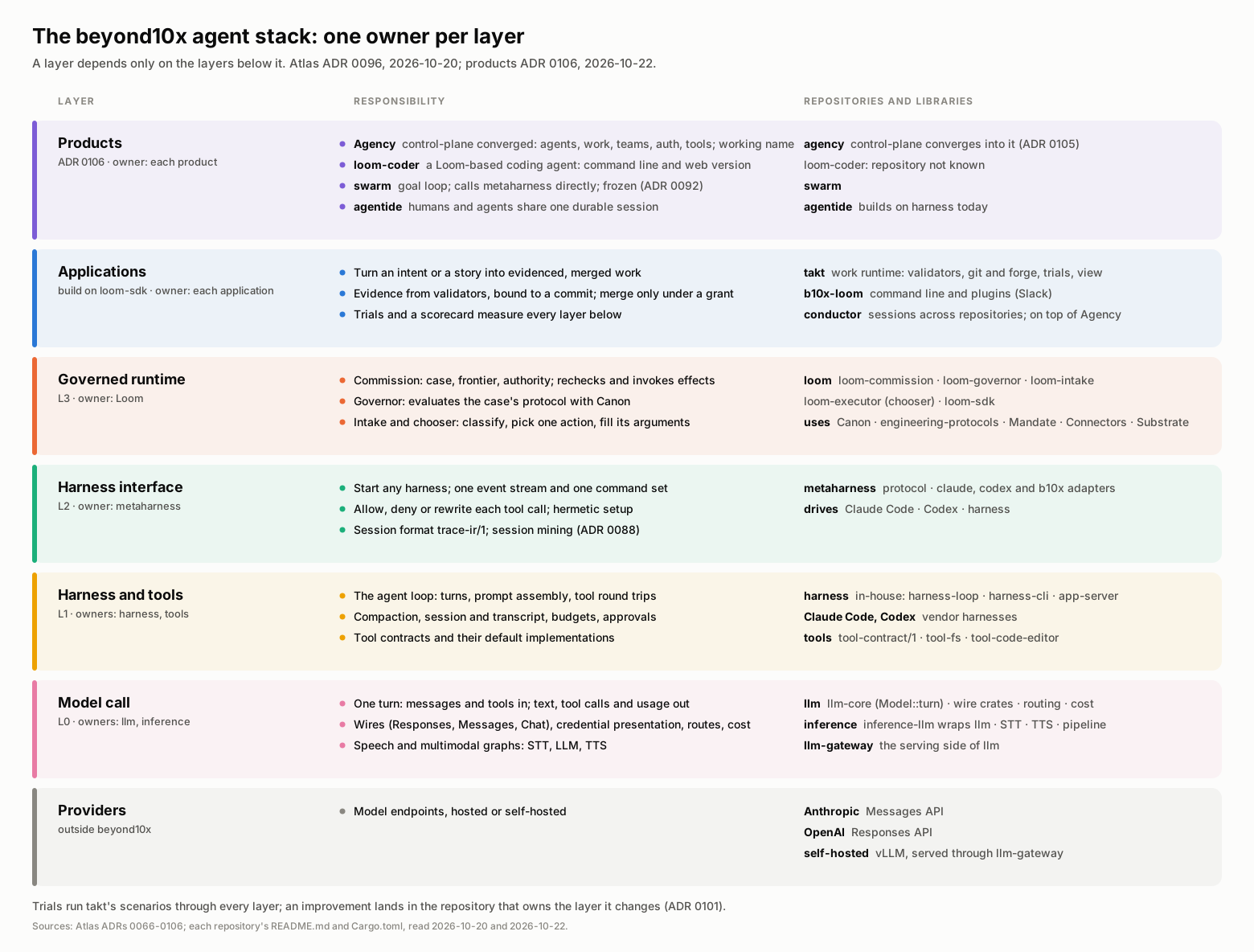
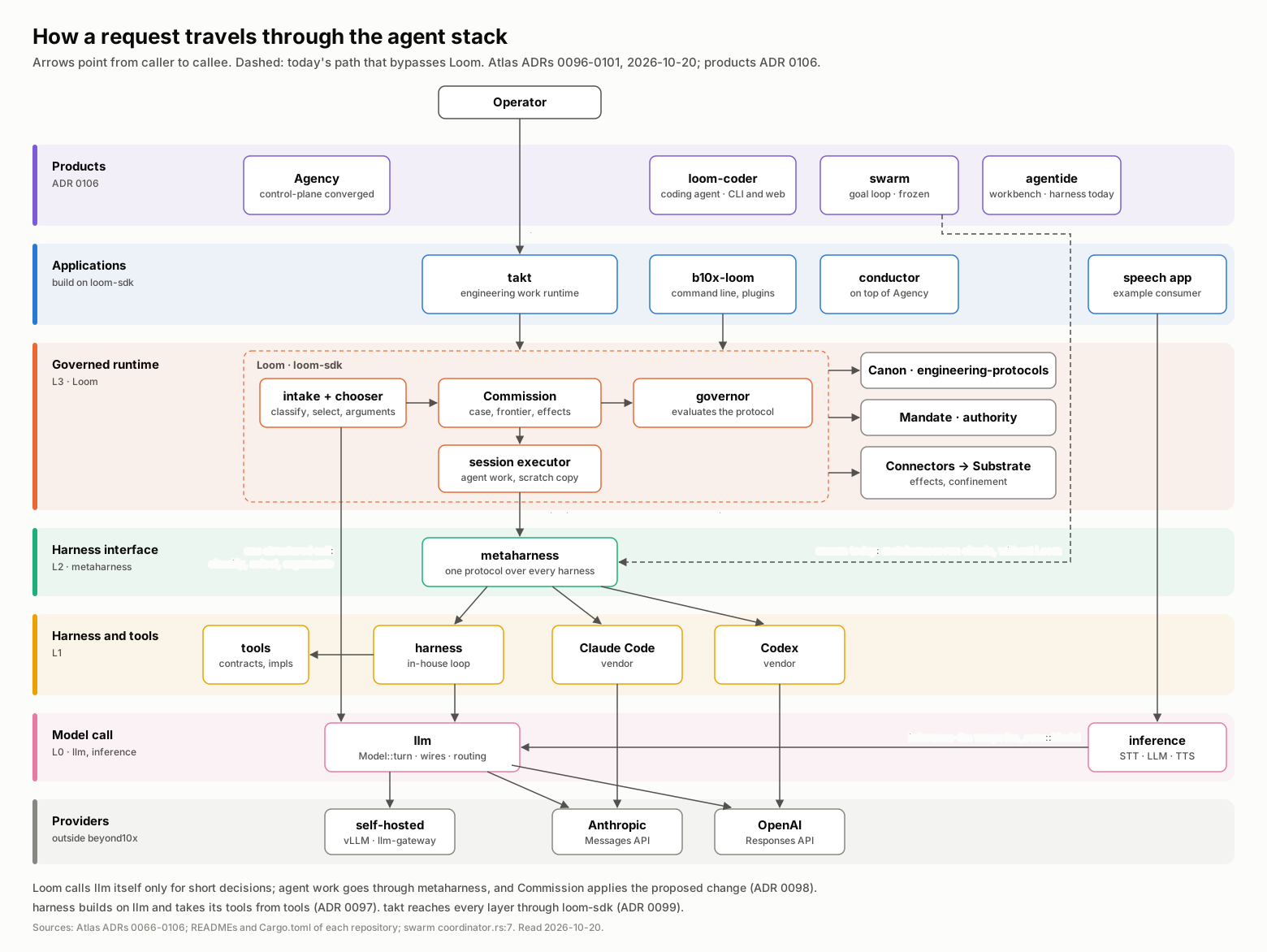
Download the deterministic graph projection. Agent stack Open the agent stack as an interactive page: the layers assemble as you scroll, a call travels down them, and every term links to its definition and repository. Pan the full-size diagram: swipe or scroll, or focus the canvas and use the arrow keys. Products (Agency, loom-coder, swarm, agentide) are what a person uses; loom-coder has no repository yet. Applications (takt, b10x-loom, conductor) build on loom-sdk; conductor sits on top of Agency. L3, the governed runtime, is Loom. L2, the harness interface, is metaharness. L1 is harness, Claude Code and Codex, with tools. L0, the model call, is llm and inference. Providers (Anthropic, OpenAI, self-hosted through llm-gateway) are outside beyond10x. Pan the full-size diagram: swipe or scroll, or focus the canvas and use the arrow keys. The operator gives takt an intent or a story. takt opens a case in Loom through loom-sdk. Loom calls llm directly for short decisions (classify, select, fill arguments) and runs agent work as a session through metaharness, which drives harness, Claude Code or Codex. Those call llm, which calls the provider. Commission in Loom applies the proposed change. More columns: swipe horizontally, or focus the table and use the arrow keys.One owner per layer
Layers as text
Request path as text
Definitions
Term Layer What it does Owned by Model call L0 One turn in, one turn out: messages and tools in; text, tool calls and usage out. Owns provider wires, credential presentation, routes and cost; custody and OAuth2 refresh of a credential belong to Connectors. llm (GitHub), inference, llm-gatewayHarness L1 The agent loop: turns, prompt assembly, tool round trips, compaction, session and transcript, budgets. Claude Code and Codex are vendor harnesses; tools holds the tool contracts. harness (GitHub), toolsMeta-harness L2 Starts any harness behind one event stream and one command set, allows, denies or rewrites each tool call, and records every session as trace-ir/1. metaharness (GitHub) Agent runtime L3 · governed runtime Loom; loom-sdk is its library. Opens a case on a protocol and lets a model act only through the actions the case admits at that moment. Calls llm for its own short decisions and metaharness for agent work. LoomApplication above L3 An end-to-end use of the stack, built on loom-sdk. takt delivers stories and counts nothing done until a validator records the evidence; it manages agents and is not one. conductor coordinates Claude Code sessions across the repositories of one organization and sits on top of Agency. takt, conductorProduct above the applications What a person uses on top of the stack. Agency is where the operator manages agents, work, teams, auth and tools; control-plane converges into it. loom-coder is a Loom-based coding agent with a command line and a web version; it has no repository yet. Agency, loom-coder, swarm, agentide